Rates current as at May 2026. Subject to change. Take independent tax advice for your specific circumstances.
Xero bookkeepers are the people who keep your Xero file accurate, reconciled, and HMRC-ready. They are not the same as Xero accountants, although the two roles overlap. The sections below cover what a Xero bookkeeper does, when you need one versus when you do not, what to pay, what to look for in a Xero Certified bookkeeper, how to find one near you in Manchester or anywhere in the UK, and the honest case for doing bookkeeping in-house.
Xero now has over 4.4 million subscribers globally and is the cloud accounting platform of choice for most UK small businesses started in the last decade. Around half of those subscribers use a Xero Certified Advisor (the bookkeeper / accountant designation) to manage some or all of their books. The right choice for your business depends less on your turnover and more on how much time the owner can defensibly give to data entry and reconciliation each week.
What does a Xero bookkeeper actually do?
A Xero bookkeeper keeps the day-to-day data inside Xero accurate. The core tasks they own (and the owner does not have to) are:
- Bank reconciliation. Matching every line on the bank feed to a sales invoice, supplier bill, expense claim, transfer, or other receipt. Done weekly for an active trading business; monthly is acceptable for low-volume businesses.
- Customer invoicing and credit control. Raising invoices on time, sending statements, chasing overdue accounts. This is often where the biggest cash flow improvements come from.
- Supplier bill entry. Capturing supplier invoices into Xero (via Hubdoc, Dext, or email-to-Xero), coding them to the right account and VAT rate, scheduling payment runs.
- Payroll posting. Running monthly payroll (often through Xero Payroll or a connected payroll system), filing RTI to HMRC, posting the journal into the nominal ledger.
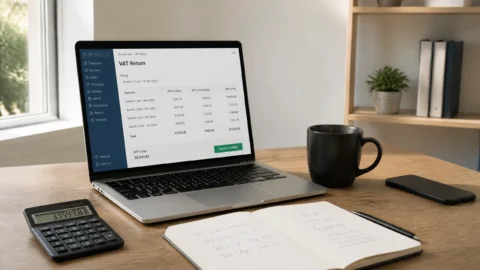
- VAT return preparation. Pulling the quarterly VAT return together, running the VAT Audit, flagging anomalies for the owner to confirm before submission.
- Month-end close. Posting accruals and prepayments, depreciation journals, intercompany balances, ready for a clean management report.
What a bookkeeper does NOT do (and a chartered accountant does) is statutory year-end accounts, corporation tax computations, complex tax planning, audit, or strategic advisory work. Many small businesses use a bookkeeper for the monthly grind and a chartered accountant for the annual filings.
Worked example: cost of a Xero bookkeeper vs doing it yourself
A growing e-commerce business in Trafford, three years old, 18 staff, £850,000 turnover, on Xero Standard at £33 per month. The owner was doing all the books in evenings until month 14 then engaged a part-time Xero bookkeeper for 12 hours a week at £32 per hour. The figures below contrast the year before and the year after.
| Cost or value line | Year 1 (DIY) | Year 2 (bookkeeper) |
|---|---|---|
| Xero subscription | £396 | £396 |
| Bookkeeper fee (52 weeks x 12hr x £32) | £0 | £19,968 |
| Owner time on books (annualised at £55/hr) | £17,160 (6hr/wk) | £2,860 (1hr/wk) |
| Year-end accounts (cleaner books) | £3,200 | £2,400 |
| VAT penalties (late filing year 1) | £600 | £0 |
| Late-payment debtor recovery | 15 day average | 9 day average (£18,400 cash flow benefit) |
| Total visible annual cost | £21,356 | £25,624 |
On paper the bookkeeper looks £4,268 more expensive. The real picture is different. The owner recovered 5 hours per week (260 hours over the year) of capacity that went straight into sales, taking the business from £850,000 turnover to £1,180,000 in year 2. The 6-day improvement in average debtor days released £18,400 of working capital. The £600 VAT penalty disappeared. By any honest measure the bookkeeper paid for themselves three times over.
DIY, Xero bookkeeper, or full-service accountant?
| Aspect | DIY in Xero | Xero bookkeeper | Full-service accountant |
|---|---|---|---|
| Monthly cost | £33 (Xero only) | £250 to £1,200 | £400 to £2,500 |
| Owner time / month | 15 to 25 hours | 3 to 5 hours | 1 to 2 hours |
| Covers VAT returns | Yes (you file) | Yes (they file) | Yes |
| Covers payroll | Optional | Usually | Yes |
| Year-end accounts and CT600 | No (need separate accountant) | No (need separate accountant) | Yes |
| Strategic / tax planning | No | Limited | Yes |
| Best fit by size | Pre-VAT or under £100k turnover | £100k to £1m turnover | £500k+ with growth ambition |
When you need a Xero bookkeeper (and when you do not)
- If you spend more than 8 hours a week on the books, a bookkeeper will almost certainly pay for themselves. The capacity you recover from data entry tends to flow straight back into the revenue side of the business.
- If you have employees and run monthly payroll, hand off the payroll posting and HMRC RTI submissions. Payroll mistakes are slow, expensive to unwind, and damage staff trust.
- If your bank feed sits unreconciled for more than 14 days, your VAT return is at risk and your management reports are unreliable. A part-time bookkeeper fixes this within a fortnight.
- If you are still doing the books in Excel and then re-keying into Xero, you are paying for software you are not using. A bookkeeper will migrate the workflow into Xero properly.
- If your turnover is under £80,000 and you have no employees, you probably do not need a bookkeeper. The basic Xero workflows (bank rules, automatic invoicing, Hubdoc receipt capture) can be owner-run with 2 hours a week.
- If you only need someone for year-end accounts and tax, a chartered accountant is the right choice, not a bookkeeper. The two roles are different.
How to find a Xero Certified bookkeeper in Manchester or the UK
Xero runs a public Advisor Directory at xero.com/uk/advisors that lists every Certified Advisor by location, certification level, and industry experience. Filter by your postcode and look for:
- Xero Certified Advisor as the minimum bar. This means they have passed the Xero certification exam and they actively use the platform.
- Silver, Gold, Platinum partner status shows volume of active Xero clients. Platinum and Diamond firms typically have 100+ Xero clients and very deep platform knowledge.
- Industry specialism. Many bookkeepers specialise in e-commerce, construction (CIS), hospitality, professional services, or property. The right specialism saves you a fortune in mis-coded transactions.
- Reviews and references. Ask for two references from clients of similar size. A good bookkeeper will offer this freely.
- ICB or AAT membership. The Institute of Certified Bookkeepers and the Association of Accounting Technicians both run member registers and complaints processes. Independent bookkeepers without any professional body affiliation are higher risk.
Common scenarios when you start with a Xero bookkeeper
- Your existing Xero file is a mess from 18 months of DIY. Expect the first month to be a clean-up project, not BAU. A good bookkeeper will quote a separate fixed-fee for the catch-up work (typically £400 to £2,000) before settling into monthly retainer.
- You want to keep some control over invoicing. Tell the bookkeeper at engagement. Most are happy to leave sales invoicing with you and own only the bank, bills, and reconciliation. Adviser permissions inside Xero make this easy.
- You are using Hubdoc, Dext, or AutoEntry already. Confirm the bookkeeper is fluent in your receipt-capture tool. Most are; some will recommend switching to a different tool and that is a flag to discuss why.
- The bookkeeper wants Standard role, not Adviser. That is correct. Adviser is reserved for the qualified firm that signs your annual accounts. A bookkeeper without statutory-accounts authority gets Standard plus Reports.
- You are moving from a different software (QuickBooks, Sage, FreeAgent). The bookkeeper will project-manage the conversion, usually via Movemybooks or Jet Convert. Budget two weeks of overlap parallel-running.
Frequently Asked Questions
How much does a Xero bookkeeper cost in the UK?
Hourly rates run from £25 per hour for newly qualified independent bookkeepers to £65 per hour for senior bookkeepers in established firms. Fixed-fee monthly retainers run from £180 per month for a sole trader to £1,200+ for businesses processing 200+ transactions per month. Most small businesses end up between £300 and £600 per month.
What is the difference between a bookkeeper and an accountant?
A bookkeeper keeps the day-to-day data accurate (bank reconciliation, invoicing, bills, VAT). A chartered accountant signs the statutory accounts, files the corporation tax return, and provides tax planning and advisory work. Many small businesses use both: a bookkeeper for the monthly grind, an accountant for the annual filings.
Do I need a Xero Certified Advisor or any Xero bookkeeper?
Xero Certified Advisor is the minimum bar for any bookkeeper who claims Xero expertise. The certification proves they have current platform knowledge (Xero updates monthly). A non-certified bookkeeper may know the basics but is unlikely to know the newer features (Xero Analytics Plus, Tap to Pay, the latest bank-rule logic) that save you the most time.
Can a Xero bookkeeper file my VAT returns?
Yes, if they are listed as an agent on your HMRC business tax account and have Xero Adviser or Standard plus Reports permissions. They will pull the VAT return from Xero, review it, get your sign-off, and submit through the MTD API.
Where can I find a Xero bookkeeper in Manchester?
The Xero Advisor Directory (xero.com/uk/advisors) lists every Certified Advisor by postcode. For Manchester, JacRox (the cloud accounting arm of Jack Ross Chartered Accountants) is a Xero Silver Partner serving small businesses across Greater Manchester and the North West. Other Silver and Gold partners are listed in the directory.
How long does it take to engage a Xero bookkeeper?
From first call to first reconciliation is typically two weeks. The bookkeeper needs to be added as a user to your Xero file, AML checks completed, engagement letter signed, and an opening review done before they take over. A clean Xero file shortens this to a week.
Can I switch bookkeepers without losing my Xero data?
Yes. Your Xero file belongs to you, not your bookkeeper. Remove their user access and add the new bookkeeper. The data stays put. The new bookkeeper will spend the first month reviewing the old work and noting any treatment they want to change. There is no data migration involved.
Further reading
- Xero Advisor Directory (UK)
- Institute of Certified Bookkeepers (ICB)
- Association of Accounting Technicians (AAT)
- gov.uk: Choosing an accountant or bookkeeper
- ICAEW: Find a Chartered Accountant
Related Xero guides
- Why Xero Is the Bookkeeping Software UK SMEs Pick
- Xero Bank Reconciliation Made Simple
- How to Add an Accountant to Your Xero Account
- Jack Ross Chartered Accountants: parent firm services
Speak to a Manchester Xero bookkeeper
In our experience of running Xero books for small businesses across the North West, the businesses that get the most from bookkeeping are not the largest. They are the ones whose owner spent the previous 18 months doing the bank reconciliation in evenings and weekends, who has reached the point where the time cost finally outweighs the fee. We have seen a 25 per cent jump in management-account accuracy within two months of handover for clients in that profile. Our position is that the right time to engage is six months earlier than most owners feel they need to.
JacRox is the Xero cloud accounting arm of Jack Ross Chartered Accountants, an ICAEW-regulated chartered firm founded in 1948 and based in Manchester. We are a Xero Silver Partner. Our bookkeepers and chartered accountants work as one team, so your bookkeeping, VAT, payroll, year-end accounts, and tax planning all live in one place rather than scattered across three providers. If you would like to discuss whether bookkeeping with us is right for your business, get in touch via our contact page or call us on 0161 832 4451.